1. What is rain enhancement?
Rain enhancement is the process of increasing the amount of precipitation from existing weather systems. Our technology uses ionization to enhance natural rainfall by creating negatively charged particles that are carried by natural air currents into clouds, where they help water droplets grow larger and fall as rain.
2. How does your technology work?
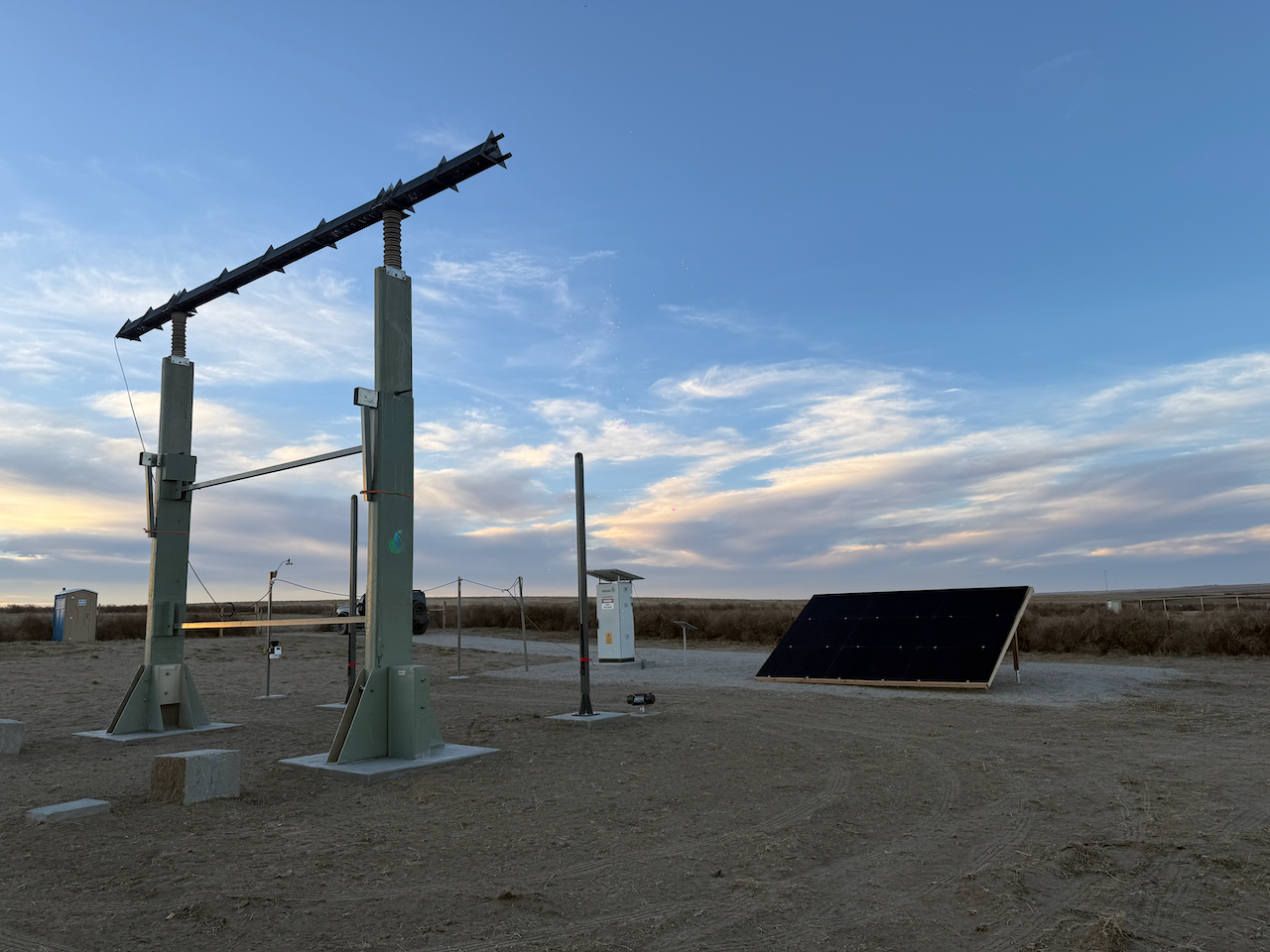
Our WETA (Weather Enhancement Technology Array) systems create negative ions using naturally occurring wind patterns. WETA uses a high voltage DC charge to create corona inception points releasing electrons that ionize passing air particles. These ionized particles are carried up to cloud layers at around 2,000 feet altitude. In the clouds, the charged particles help accelerate the collision and combination of water droplets, causing them to become heavy enough to fall as rain.
3. What makes your approach different from other rain enhancement methods?
Unlike chemical cloud seeding that requires aircraft and silver iodide, our ground-based ionization technology:
- Is proven to be effective in warm climates and temperatures well above 32°F
- Uses no chemicals or external feed materials
- Operates automatically from the ground with greater frequency than aircraft-based methods
- Works with natural weather patterns
- Requires minimal ongoing maintenance
- Is environmentally friendly and contributes to decarbonization goals
4. How effective is the technology?
Based on a six-year trial in Oman (one of the world’s most water-stressed regions), ionization technology using the WETA design achieved:
- 17.6% average rainfall enhancement over the trial period
- Statistically significant results in precipitation gauges up to 70km from the ionization devices
- Consistent performance across varying weather conditions
Reference: Chambers, R., et al. (2022). Journal of the Royal Statistical Society: Series A (Statistics in Society), 185(4), 1584–1612.
5. Why does a 20% increase in precipitation matter?
A 20% increase in precipitation across large service areas translates to substantial acre-feet of additional water. This enhanced precipitation delivers multiple benefits:
- Replenishes groundwater, aquifers, wells, and natural storage systems
- Delivers better crop outcomes than irrigation with less water input
- Requires lower energy costs than alternative water sources like desalination or pumping
- Acts as a scale multiplier for existing water resources
6. What area does one system cover?
A single Rain Enhancement Device can influence precipitation across up to 230,000 acres/360 sq. miles. For optimal results, we typically install multiple devices in a network with independent devices activated based on wind conditions and weather patterns.
7. How long from contract to operational results?
Our systems are typically operational within 3-6 months, depending on site requirements and local permitting. Simple installations can be completed in as little as 3 months, while more complex sites may require the full 6 months for permitting and preparation.
8. What permits or approvals are needed?
Permitting requirements vary by location and jurisdiction. Our field application engineers work with you to:
- Identify necessary local permits and approvals
- Assist with regulatory compliance
- Coordinate with authorities as needed
- Ensure all installations meet local requirements
9. What are the site requirements?
Each installation requires:
- Approximately 5,800 square feet of land, which can be divided into smaller plots
- 25+ feet clearance from trees and other structures
- Installation away from power lines, transmission towers and other tall metal structures
- Site upwind of the area requiring the enhancement
Locations similar to those suitable for wind turbines work well, but the system can be effective anywhere there is naturally occurring rainfall.
10. How is the system powered?
Our systems operate completely off-grid using solar power with battery storage. The solar array provides sufficient power for operation in most US locations and requires minimal maintenance. Alternative power sources (generator, wind, grid, etc.) can be used if needed.
11. What maintenance is required?
The system is designed for minimal maintenance and operating costs:
- 15-year equipment lifespan
- Remote monitoring and control capabilities
- No ongoing feed materials or chemical inputs required
- Periodic inspection and basic maintenance similar to solar installations
- Array wire is typically replaced every operating season
12. How do you measure and report results?
We establish a network of rain gauges using World Meteorological Organization (WMO) compliant equipment to document water production. We create baseline measurements from your area’s historical weather patterns. Your custom monthly reports show measurements from rain gauges both inside and outside your service area, providing clear documentation of additional water generated.
14. Can rain enhancement affect hail?
While RET’s ionization technology has not yet been tested for hail mitigation, other weather modification methods show promise in this area. Chemical cloud seeding—the method used in programs across Montana, North Dakota, and parts of Canada—aims to reduce hail damage by releasing moisture earlier in storms, which can prevent ice crystals from building into larger, more damaging hailstones. The approach works by changing storm dynamics to theoretically lower overall hail risk.
The potential for hail reduction has attracted significant attention: Canadian insurance companies actively fund cloud seeding programs before predicted hailstorms to reduce claim severity, demonstrating industry confidence in the technology’s protective benefits.
RET hopes to test whether our ionization technology can deliver similar hail mitigation benefits in sometime in the future.
15. Can rain enhancement "steal" rain from other areas?
No. Decades of global research confirm that “cloud theft” is not possible. Natural clouds release only about 9% of their moisture as precipitation. Even a 20% enhancement only increases this to approximately 11%, leaving the vast majority of atmospheric moisture available. Additionally, our open atmospheric system continuously replenishes moisture from oceans and land surfaces. Enhanced precipitation in one area does not reduce water availability elsewhere.
16. Can WETA intensify or modify severe winds in storms?
It is very unlikely. There have been no rigorous studies performed to answer the specific question as to whether ionization could intensify severe winds in storms. However, the lack of research into this question is indicative of the exceedingly low likelihood of there being any possible interaction. Such a study would almost certainly yield a null result.
A storm that produces severe winds requires a pre-storm environment that is primed for severe weather. Forecasters are able to identify the threat of severe weather days in advance based on the predictability of the larger-scale pre-storm environmental conditions. Certain environments are primed for severe windstorms. There is no known technology, using ionization or other techniques, that has the capability of altering these pre-storm environments. If weather tech is operating in an environment that doesn’t contain a primed environment, then the weather tech alone cannot conceivably generate severe weather. The simplest solution to avoid any remote possibility of generating severe weather via the influence of weather tech is simply to suspend operations whenever we observe or predict a primed environment. This is a 100% failsafe strategy that we employ at RET.
17. How does this compare to traditional cloud seeding?
Our ionization method is an excellent complement to traditional cloud seeding:
- Traditional cloud seeding works better in winter conditions and increases snow
- Our ionization technology works in warmer conditions (above 32°F) and increases rain
- Together, they can provide year-round precipitation enhancement
- Our method requires no aircraft or chemical materials like silver iodide
18. Is the technology safe?
Yes, our ionization technology:
- Uses established physics principles that have been studied since the 1940s
- Requires no external chemical materials
- Has been successfully tested over six years in operational conditions
- Does not produce harmful emissions or by-products
- Installations are remotely monitored and include automatic safety shutdowns
- Systems are installed in fenced, secure locations
- The negative ion technology uses the same principles as commercial air purifiers
19. Who brings expertise to this technology?
Our team includes leading experts from multiple fields:
- Atmospheric physicists and meteorologists from major universities
- Former weather modification specialists with decades of experience
- Technical advisors with backgrounds in electrical engineering and cloud physics
Collaborations with research institutions
20. Where has this technology been proven?
Our technology has been validated through multiple international trials:
- Oman’s Hajar Mountains (2013-2018): 200+ automatic weather stations, 200+ rain gauges on 6km grid, 12 devices operated over 6 years, comprehensive data collection over 122,259 gauge-days
- Additional trials conducted in Australia, Jordan, and China with published results
- United States operations (2025-present): Two installations now operational—one in Gill, Colorado covering agricultural land in Weld County, and one in Grand County, Utah targeting the La Sal Mountain Range for both rainfall and snowpack enhancement. Both installations are showing promising early indicators of enhanced precipitation and are operating under state permits with ongoing monitoring and reporting.Primary reference: Chambers, R., et al. (2022). Journal of the Royal Statistical Society: Series A (Statistics in Society), 185(4), 1584–1612.
21. What types of organizations benefit from rain enhancement?
Our technology serves various water-stressed organizations:
- Water agencies seeking additional supply sources
- Agricultural operations needing irrigation water
- Energy producers requiring cooling water
- Real estate developers in water-limited areas
- Resorts and golf courses maintaining landscapes
- Large landowners managing water resources
- Native American tribes enhancing water security and sovereignty
22. How does this complement existing water strategies?
Rain enhancement works alongside traditional water supply methods:
- Enhances rather than replaces comprehensive water planning
- Offers a cost-effective addition to desalination, recycling, and conservation
- Supports long-term water security planning
- Provides additional water supply resilience
23. What's the long-term commitment?
Our service includes:
- 15-year system lifespan with minimal ongoing costs
- Rain gauge network and annual water production reporting
- Remote system operation and maintenance
- Ongoing optimization based on local weather patterns
- Automated monitoring and full-time meteorological team oversight to shut down operation in advance of adverse weather conditions